What is the Lutheran Church?
First, the Lutheran Church is a continuation of the Apostolic Church that grew from the words and example of Jesus and the teachings of the Apostles. We are Christians, but we do not claim to be the only Christians or that we have everything right. The Lutheran Church is not a denomination in the way most people use that word today. It does not exist as one option among many on a Sunday-morning menu, alongside Baptist and Pentecostal and non-denominational. It exists for a different reason, and it understands itself differently.
The Lutheran Church is the church of the Reformation — the first body of Christians to break from Rome in the sixteenth century — and yet it never thought of itself as breaking from the Church itself. The Reformers did not believe they were starting a new church. They believed they were recovering an old one. The faith of the apostles. The faith of the Church Fathers. The faith of Nicaea and Constantinople and Chalcedon. The faith that had been preached, prayed, and protected for fifteen hundred years before Luther was born.
The Name Luther Did Not Want
There is something worth admitting up front about the word Lutheran.
Martin Luther never wanted the church to be called by his name. The thought would have horrified him. He wrote plainly: "I ask that men make no reference to my name; let them call themselves Christians, not Lutherans. What is Luther? After all, the teaching is not mine."
He meant it. Luther did not see himself as the founder of a new church. He saw himself as a servant calling the Church back to what it had always been, the one, holy, catholic, and apostolic Church confessed in the Creeds, the Church of the apostles and the Fathers, the Church whose gospel had been obscured but never destroyed. He believed he was recovering the historic Christian faith, not inventing a new one.
His opponents began calling his followers "Lutherans" as an insult, suggesting that this was a man-made movement, the followers of a single German Friar, rather than the historic Church. The label stuck. After five hundred years, we still wear it. Luther would have preferred we did not.
So what is the better name?
Evangelical Catholic.
Evangelical, from the Greek word euangelion, meaning good news, because the gospel of Jesus Christ crucified and risen for sinners is the heart of everything we believe and confess.
Catholic, from the Greek katholikos, meaning according to the whole, because we confess the universal Christian faith preserved in the Creeds, taught by the Church Fathers, and handed down without break from the apostles to today.
When we use the word catholic here, we do not mean Roman Catholic. We mean what the word has always meant in the historic creeds: the universal Christian faith, belonging to all believers in every time and place. It has nothing to do with Rome. It has everything to do with the whole Church of Christ across all ages.
Together: gospel-centered and rooted in the whole historic Church. That is who Lutherans actually are. That is what the Augsburg Confession of 1530, the founding document of the Lutheran Reformation, explicitly claimed for itself: that "nothing has been received among us, in doctrine or in ceremonies, that is contrary to Scripture or to the catholic Church."
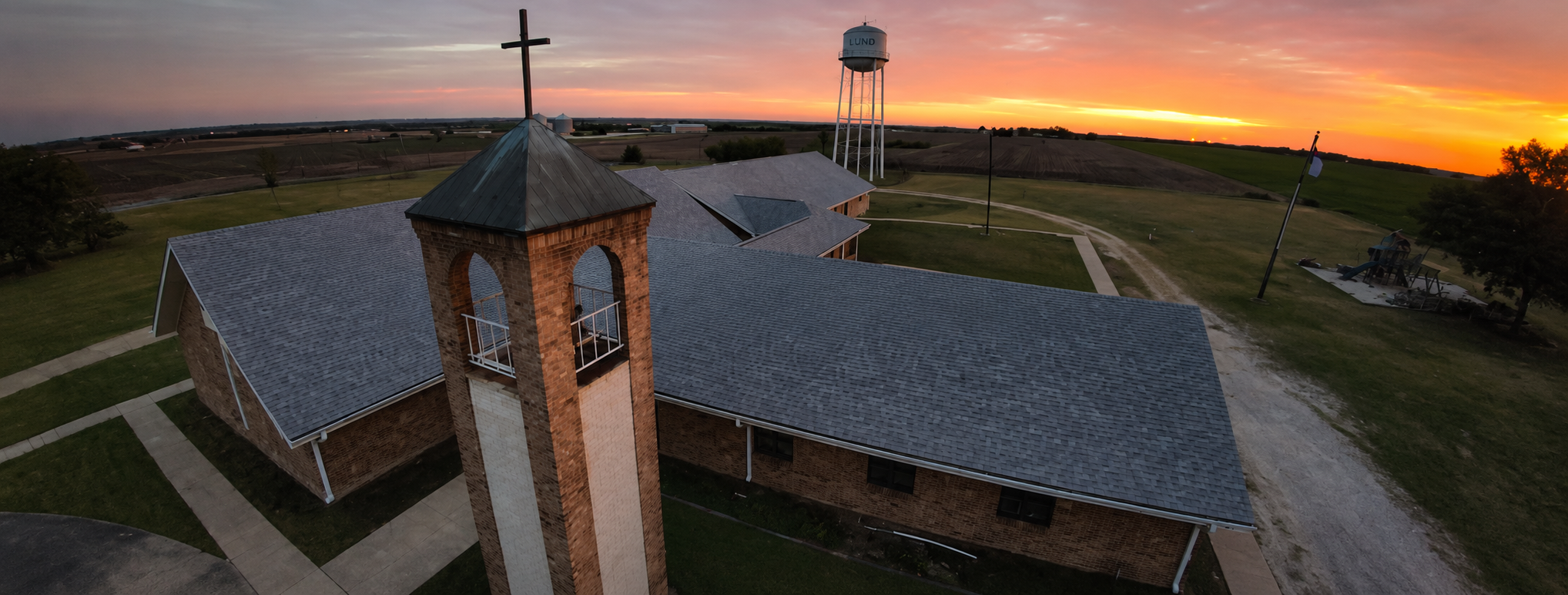
The sign on our building says Bethlehem Lutheran Church because that is the name history gave us. But what we actually are is the Evangelical Catholic Church, the gospel-centered, creedal, sacramental, historic Christian Church that has been worshipping in Lund, Texas since 1897, and in the world since Pentecost. When you walk into Bethlehem, you are not walking into the church of Luther. You are walking into the Church of the apostles, the martyrs, the Fathers, and the saints. Luther himself would point you past his own grave and toward the altar.
Not Non-Denominational. Interdenominational.
This is why you will often hear it said that the Lutheran Church is not so much non-denominational as interdenominational. Many churches today claim to be non-denominational, meaning they have no creed, no confession, no historical roots, and no accountability to anything beyond their own local leadership. The Lutheran Church is the opposite. It has every creed the early Church wrote. It has the Book of Concord. It has the Fathers, the councils, and the unbroken witness of the historic Church. And precisely because it stands in that ancient stream, it is at home with Christians from every tradition who confess the same faith. The Lutheran does not feel like a stranger praying the Apostles' Creed in a Catholic church, the Nicene Creed in an Orthodox liturgy, or the Athanasian Creed in an Anglican service. These are not their words. They are ours, and theirs, and the Church's. We did not invent them. We received them.
People from every walk of life have found a home in the Lutheran Church for this reason. Former Roman Catholics, who recognize the historic faith and the sacramental life they were given as children but who longed for the gospel preached with clarity. Former evangelicals, who loved the gospel but grew tired of churches that had no roots, no liturgy, no creeds, and seemed to be remade every five years to match the culture. Former Pentecostals, who wanted to be fed something more substantial than emotional experience. Former mainline Protestants, who watched their denominations drift away from Scripture and wanted to find the historic Christian faith again. Former unbelievers, who came in skeptical and stayed because they found something old, true, and unchanging in a world that promised neither.
Former mainline Protestants of every tradition, Methodist, Presbyterian, Episcopal, who were formed in a church that valued ordered worship, the historic creeds, and the liturgy of the Church, and who have watched that tradition change in ways they did not choose and did not expect. If you grew up singing hymns, confessing a creed, and receiving communion at a rail, and you are looking for a place where that is still what Sunday morning looks like, you are not looking for something new. You are looking for something real. So are we.
If you grew up in any of those traditions, you will not feel like a stranger here. The hymns, the creeds, the liturgy, the Scripture preached without apology, these were handed to your tradition from this one. You are not converting. You are tracing the river back to where it starts. And if you were baptized in another Christian tradition, you will not be asked to be baptized again. Lutherans recognize every baptism performed in the name of the Father, Son, and Holy Spirit. Your baptism is valid, permanent, and the ground you stand on. What Bethlehem offers is not a new beginning. It is a continuation of the same grace you were given at the font, wherever that font was.
The Lutheran Church welcomes them because the Lutheran Church is not a sect. It is the historic Christian Church, preached and confessed and lived as it has been for two thousand years.
Bethlehem and the LCMC
Bethlehem Lutheran Church is a member congregation of Lutheran Congregations in Mission for Christ (LCMC), a worldwide fellowship of confessional, mission-minded Lutheran congregations.
LCMC congregations are independent and locally led. There is no distant bureaucracy directing what is preached at our altar. The congregation calls its own pastor, owns its own property, and is accountable for its own ministry. But LCMC congregations are not isolated. We are gathered together for shared mission, theological accountability, the support of seminaries that train faithful pastors, and the common work of proclaiming the gospel.
LCMC stands firmly in the historic Lutheran confession, committed to the authority of Scripture, the truth of the ecumenical creeds, the Lutheran Confessions of the Book of Concord, and the proclamation of Christ crucified and risen for the forgiveness of sins. We are not a new denomination. We are an old one, gathered freshly for the work of the Church in our time.
If you are looking for a Lutheran congregation that has not drifted, that still preaches the gospel and administers the Sacraments as the Lutheran Church always has, a congregation that is, in the truest and oldest sense, Evangelical Catholic — you have found one.
Many Lutherans today are looking for a church that has not drifted from the historic confession. The largest Lutheran body in America, the ELCA, has moved away from confessional Lutheranism over the past several decades. Bethlehem is not ELCA. We are LCMC, a fellowship of confessional Lutheran congregations committed to Scripture, the ecumenical Creeds, and the historic Lutheran Confessions.
What Lutherans Believe
The shortest answer to that question is this: Lutherans believe what the Church has always believed.
We did not invent our faith. We received it from the apostles, who received it from Christ. It was guarded at Nicaea by bishops who had been tortured for refusing to deny it. It was carried through fifteen hundred years of preaching, baptizing, and breaking bread. It was recovered and re-articulated by the Reformers when it had been obscured by medieval additions. And it is what we still confess every Sunday at Bethlehem.
Here is the heart of it.
The Bible Is the Word of God
We believe that the Holy Scriptures, the Old and New Testaments, are the inspired, inerrant Word of God, true in everything they teach. Scripture is the final authority for what the Church believes, preaches, and confesses. Where Scripture speaks, the Church listens. Where Scripture is silent, the Church does not bind anyone's conscience.
We Are Saved by Grace, Through Faith, on Account of Christ
This is the heart of the gospel, and the heart of the Christian witness. Grace alone. Faith alone. Christ alone.
You are not saved by your moral effort, your sincerity, your church attendance, your good intentions, or your spiritual experiences. You are saved entirely by what God has done for you in the death and resurrection of Jesus Christ. The cross is not an example for you to follow. It is a debt paid on your behalf, fully, finally, and once for all. The righteousness by which you stand before God is not your own. It is Christ's, given to you as a gift, received by faith.
This is why the Lutheran service does not ask you to perform. It asks you to receive.
God Actually Delivers What He Promises in the Sacraments
We believe Baptism is more than a symbol. In the waters of Baptism, God makes a person His own. He delivers forgiveness, creates faith, and joins the baptized to the death and resurrection of Christ. What happens at the font is the most important thing that ever happens to a person, not because of the water or the words on their own, but because God has bound His promise to them.
We believe the same about the Lord's Supper. When Christ said "this is my body, this is my blood," He meant it. In the bread and the wine of Holy Communion, the body and blood of Christ are truly present, given for the forgiveness of sins. The Lord's Supper is not a re-enactment, a memorial, or a metaphor. It is Christ Himself, present at His own table, feeding His people the gifts He won for them on the cross. That is what is known as one of the mysteries of Christ.
This is what Lutherans mean by Word and Sacrament. The gospel preached. The gospel delivered. Both. Every Sunday.
The Historic Christian Faith
We confess the three great creeds of the universal Church, the Apostles' Creed, the Nicene Creed, and the Athanasian Creed, because these are not Lutheran inventions. They are the faith of the Church, summarized at enormous cost by people who guarded it through persecution and refused to dilute it. The Lutheran Confessions, gathered in the Book of Concord (1580), do not add to that faith. They confess it clearly against the errors that have always tried to obscure it.
When you stand and confess the Creed at Bethlehem, you are standing in the same line as the early Christians who were beaten and even killed for the right to say "true God from true God, begotten not made." You are confessing what the Church has confessed in every generation, in every language, on every continent.
That is what we mean when we say our faith is old.
What This Means for the Christian Life
The Christian life, for a Lutheran, is not a performance. It is not a ladder you climb. It is not a transaction in which God grants you the desires of your heart in exchange for sincerity or effort. God is not a vending machine. He is not a genie who exists to make your life easier. He is the holy God who made you, who came to save you, and who has called you into the life He intends, which is often harder than the life you wanted, and always better.
The Christian life is lived from your baptism. Every day, the old sinful self is drowned in repentance, and the new self rises forgiven. You return to confession and absolution. You hear the Word preached. You come to the table. You go back out into your vocation as a parent, a worker, a neighbor, a friend, and you serve the people God has placed in your life. Not to earn anything. There is nothing left to earn. You serve because you have been freely given so much, and love spills out from a Christian who has actually received it.
This is real Christianity. It is not a show. It is not a self-help seminar. It is not a weekly emotional high. It is something older, deeper, and stronger than that.
If You Are Tired of the Show
If you have been to churches that felt more like concerts than worship, where the pastor sells you something every Sunday and pretends everything is roses if you just have enough faith, you are not alone. Many of the people who have found their way to Lutheran congregations came from exactly that. They were tired of being marketed to. They were tired of being told to manifest blessings, claim breakthroughs, or perform their way into God's favor. They wanted to actually go to church. They wanted to hear the gospel preached without apology, receive the Sacraments without explaining them away, and stand among other Christians confessing a faith that did not change every five years to match the culture.
If your congregation recently changed its worship style, its theology, or its accountability to Scripture, and you find yourself grieving something you cannot quite name, what you are grieving is the historic Christian faith. You knew it once. It is still here. The Lutheran Church is not for sale. It does not need to entertain you. It does not need to impress you. What it offers is older, harder, and infinitely more durable. It offers you Christ — preached, given, and received. Here at Bethlehem we have been doing it for 130 years, and we are not changing just because someone wants to throw out things that are sacred for things that are trendy.
If you have never been to a Lutheran service, do not be put off by the unfamiliarity. The service follows a set order, the same one the Church has used in various forms for two thousand years. Everything you need will be in the bulletin. Nobody will call on you, quiz you, or ask you to do anything you do not understand. If you come from a tradition that uses liturgy, you will recognize the shape of the service almost immediately. If you do not, you will find it unhurried, reverent, and focused entirely on what God gives rather than what you perform.
As Jesus said to the first people who wanted to know who He was: Come and see (John 1:39).
We will be here Sunday. There is room for you.